Sunday, August 24, 2008

Restored Blogs and YouTube

We have uploaded many of the old blogs and will begin posting new blogs this week. Check out our new 10 minute videos on our YouTube video page at http://www.generationword.com/youtube.html

Galyn Wiemers
http://www.generationword.com

Restored, Strong, Firm and Steadfast

In First Peter 5:10 Peter speaks to Christians who have been enduring some social rejection and are feeling the strain of living separate from the world. Peter lists a sequence of four things that God will do for them because of this process and through this process called suffering.

Peter writes:, “The God of all grace, who called you to his eternal glory in Christ, after you have suffered a little while, will himself restore you and make you strong, firm and steadfast.” (1 Pt. 5:10)

First, it needs to be noted that Peter writes, “after you have suffered a little while.” Although God’s plan includes suffering and takes into account trials and tribulations, the suffering is not God’s final destination for his people. The suffering will end. There is a time in our lives identified here as the time “after” suffering.

This reminds me of Paul’s words at the end of Romans: “The God of peace will soon crush Satan under your feet.” (Rm.16:20) The concept here is that believers must maintain hope and endure the process. The end of a trial will come. The end of Satan’s temptation is inevitable. Christ’s glory is revealed in us in the battle as well as it is in the victory.

James says, “Blessed is the man who perseveres under trial, because when he has stood the test, he will receive the crown of life that God has promised to those who love him.” (James 1:12) The process will produce for us. Peter says that after the suffering, in fact, even during the suffering, God will do four things for us:

1. Restore you – The Greek word “katartisei” (future, indicative, active) means “to put in order, to mend, to reestablish, to make whole.” It is a medical word used to describe the setting of a broken bone. It is also used of refitting or repairing a broken vessel or of James and John repairing their nets in Mark 1:19. Paul uses this word in Ephesians 412 when he says that the gifts of apostle, prophet, evangelist, pastor and teacher are to “prepare” God’s people for works of service. After a time of suffering, even during the time of suffering, God will establish you . . . he will prepare you . . . he will mend you . . . he will position you for the glory of Christ that is to be revealed in you. Probably refers to your character having been prepared to handle God’s plan.

2. Make you Strong – The Greek word “steridxei” (future, indicative, active) means “to set up, to fix firmly, to establish, to strengthen, to support”. A form of this word is used in the previous verse (5:9): “Resist him (Satan), standing firm (“stereos”) in the faith.” Through testing, trials and suffering God will plant your roots deep so that in the future you will be unshakable in you faith. You will be able to resist hopelessness , temptation, doubt and even Satan himself.


3. Make you Firm – The Greek word “sthenosei” (future, indicative, active) means “to strengthen, to make strong”. This word is used nowhere else in the New Testament and rarely used in Greek literature at all. If we see these words in a sequence then this word follows the mending of character and the fixing of faith but comes before grounding on the solid foundation. It would appear that this word refers to your actions and works that are made strong by God. These works would follow character and faith but proceed the final, unmovable product of the glory of Christ in you.

4. Make you Steadfast – The Greek word “themeliosei” (future, indicative, active) means “to make a foundation, to provide a solid foundation, to ground firmly”. Jesus had said that that man who hears and does the word would be like a man who built his house on the rock. The storms of this life would not be able to move this man because he was ground firmly on the truth. In the midst of future storms or suffering you will be steadfast and will not collapse.

NOTE:
Future tense – the action will take place at a future timeIndicative mood – a statement of fact. (not the mood of potential, or a command or removed from actually occurring)
Active Voice – the subject does the action. Here God himself will do each of these four things.

Conclusion of the tense, mood and voice of the four verbs: It is a statement of fact that God himself will do these four things in the future. In the context of the verse, the future is in a “little while”.

God himself will:
- restore your character so that no fault remains
- establish you faith so that nothing will shake you
- strengthen your actions so that you will finish the course
- firmly ground your life so that storms will not destroy your work.
Visit www.generationword.com

Ages of Adam, Seth, Methuselah and Others in Genesis

There is historical evidence that supports the accuracy of the document we know as the book of Genesis. One of the most challenging chapters to the modern reader is Genesis 5 where Adam to Noah’s genealogy lists people as living 930, 910, 969, etc. years. Our natural tendency is to see this as mythology, allegory, or just exaggerated record keeping. Before we reject the accuracy of this genealogical document inside the book of Genesis there are a few things we should consider.

One, this is an age that is far removed from our world today. Assuming the creation account is true and accurate then this genealogy is recording the first 10 generations of human existence. That means Adam, who was created perfect with no genetic flaws, is living and reproducing on the earth. How many genetic flaws are a perfect man and a perfect wife going to hand down to the next generation? None. Comparing this to our world where genetic problems are a daily source of medical and scientific research if is only obvious these people would live longer.

Two, sin was introduced when the first man disobeyed God. In addition to separating mankind from God, this sin corrupted man and his environment. Sin brought a growing destructive force to the human race both physically and mentally. Deterioration would continue through each generation. More than this, sin had an effect on the environment. New types of diseases are part of our modern world. There were no diseases in the Garden of Eden but since that time they have been consistently developing and growing. Quoting the United Nations Environment Program: “Changes to the environment that are sweeping the planet are bringing about a rise in infectious diseases. . . Ailments previously unknown in human beings are appearing. . .” (Feb. 22, 2005, see article here http://www.commondreams.org/headlines05/0222-02.htm ). So, in these first 10 generations disease was still a developing problem.

Third, today we are told to worry about the ozone layer. Quoting from NASA’s educational resources: “The ozone layer absorbs 97-99% of the sun's high frequency ultraviolet light , light which is potentially damaging to life on earth.” (http://www.nas.nasa.gov/About/Education/Ozone/ozonelayer.html ) According to the creation account in Genesis there was a layer of water in some form above the atmosphere surrounding the earth:
“And God said, ‘Let there be an expanse between the waters to separate water from water.’ So God made the expanse and separated the water under the expanse from the water above it.” (Genesis 1:6,7)
The “expanse” would be the atmosphere of the earth. In the next verse it is called “sky”. If the ozone layer in the atmosphere today protects us from ultraviolet light from the solar system then this layer of water (in some form) that God placed above the atmosphere would have done some filtering of dangerous waves. In the account of the flood Genesis 7:11 says “the great deep burst forth, and the floodgates of the heavens were opened.” The opening of heaven’s floodgates on the earth was the collapsing of the water above the atmosphere. It is interesting to note that life expectancy after the flood of Noah is cut in half. Noah’s son Shem lived 500 years and his grandson lived 403 years. (Genesis 11:10-22)

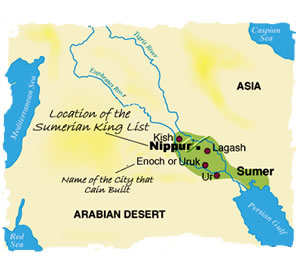
Fourth, in 1906 a list of kings who lived during the same time as the first ten generations was found in a temple library in Nippur of Sumer. (http://www.generationword.com/images/bible_school/sumer.jpg ) It is known as the Sumerian King List (http://www.livius.org/k/kinglist/sumerian.html ) It records eight kings who lived from the time “kingship had descended from heaven” up until “the Flood then swept over.” The number of the generations matches those listed in Genesis when the first man is added and the hero of the flood story is added to the eight. The length of each king’s reign is listed with the king’s name and his city. The length of their reigns is unbelievable even by biblical proportions: 28,800 years, 36,000 years, 43,200 years. What we do see here is:
a similar genealogy
a genealogy from the same time period
a genealogy from the same location
a historical document that had not been tampered with from the time of its writing on a clay tablet before 2,000 BC. There have since been 15 more ancient fragments of this same document found indicating it was a well copied document in the ancient world.
The Flood was an event recorded in ancient Sumerian documents. It is listed as occurring in the same generation as Genesis 5.
Concerning the number of years it is interesting to note that if the Sumerian King List were originally copied from a previous document that had recorded the numbers in a decimal system but the scribe wrongly used the sexagesimal system (http://www-groups.dcs.st-and.ac.uk/~history/HistTopics/Babylonian_numerals.html ) which is based on six or sixty instead of 10 to translate the numbers they would have gone from numbers very similar to Genesis 5 to the unbelievable numbers recorded now
( http://www.allaboutarchaeology.org/sumerian-king-list-faq.htm )
(http://www.answersingenesis.org/tj/v12/i3/sumerian.asp )

See galyn’s generation word notes here http://www.generationword.com/notes_for_notesbooks_pg/genesis/5_1.htm

Visit Generation Word’s home page here http://www.generationword.com/

Atheistic Crimes

I have been reading two books:
Dinesh D’souza’s “What’s So Great About Christianity”
Robert J. Hutchinson’s “The Politically Incorrect Guide to the Bible”
The first one was given to me to read by a friend and the other I bought at Barnes and Noble’s because I started reading it in the aisle and wanted to finish reading it and have it for reference.

They both make the same point and use similar statistics when comparing atheism with Christianity. It has been assumed for centuries that religion is the cause of great violence and evil in the world. I have always thought John Lennon’s song “Imagine” is the perfect example of this presumed truth. In what I consider a solid nomination for the most evil song ever written the former Beatle wrote in his hit single:

“Imagine there’s no Heaven
It’s easy if you try
No hell below usAbove us only sky
Imagine all the people
Living for today

Imagine there’s no countries
It isn’t hard to do
Nothing to kill or die for
And no religion too
Imagine all the people
Living life in peace.”

The “no religion” mantra from the 60’s and the 70’s is alive and sweeping our nation like an urban myth with email. The rise of radical Islam is the cause for a neo-secular campaign.

The murder and destruction caused by the church in history can not be ignored but it should be balanced with facts. D’souza states that those who were killed in the Spanish Inquisition trials over a period of 350 years was between 1,500 to 4,000 people. In America, the Salem witch trials are sited as examples of the result of intolerant Christian religion. On page 207 D’souza states that less than 25 people where executed in these dark days of American Christianity. Hutchinson uses the Encyclopaedia Britannica to get the number 2,000 dead in the Spanish Inquisition and the book “A History of the Jews” for an estimate of 32,000. Maximum, that is about 97 people a year.

For a total D’souza says “the Crusades, the Inquisition, and the witch burnings killed approximately 200,000 people.” That number is spread out over a 600 year period of church history. We should remember that these were the years 1095-1692. None of these tragedies have occurred in the 20th century. In fact, it has been over 300 years since the church committed these unjustifiable crimes against humanity.

Yet in the 1900’s, the 20th century, or the last one hundred years atheistic states with anti-Christian motives have killed about 170,000,000 people. Here is a list of over 40,000,000 who were killed by atheism from 1900 until present:

USSR: 61,000,000 (1917-1987)
Communist China: 35,200,000 (1949-present)
Mao’s Army: 3,400,000 (1923-1949)
Nazi Germany: 20,000,000 (1932-1945)
Communist Poland: 1,600,000 (1945-1948)
Communist Cambodia: 2,000,000 (1975-1979)
Communist Vietnam: 1,600,000 (1945-1975)
Communist Yugoslavia: 1,000,000 (1944-1987)
Anti-Christian Mexican Revolution: 1,400,000 (1900-1920)
Turkey: 1,800,000 (1900-1918)
Pakistan: 1,500,000 (1958-1987)
Japan: 5,900,000 (1936-1945)
The most deadly force in the 1900’s was atheism. Then add the 25,000,000 soldiers who died fighting in WWII against the atheists.

Compare the numbers:
The church killed 200,000 people in 597 years from 1095-1692. This figures out to be 335 people a year and includes the crusades, the inquisition and the witch trials. About one a day, 300 years ago.
Atheism has killed 170,000,000 in the last 108 years. That is 1,574,074 people a year. About 4,312 a day including everyday of your life.

The world of man is a dangerous and ugly place, but mankind is safer and more beautiful when he embraces his creator and recognizes that there is absolute truth and absolute evil.

John Lennon ends his song “Imagine” by singing:

“You may say that I’m a dreamer
But I’m not the only one
I hope someday you’ll join us
And the world will live as one.”

Lennon was indeed a dreamer, and a prophet of false dreams.
Our only hope is to proclaim the truth and defend individual freedom to respond.